
Publication on AMOS 2026: Dichotomizing Temporarily Bound Objects Using Capture States
Project Overview
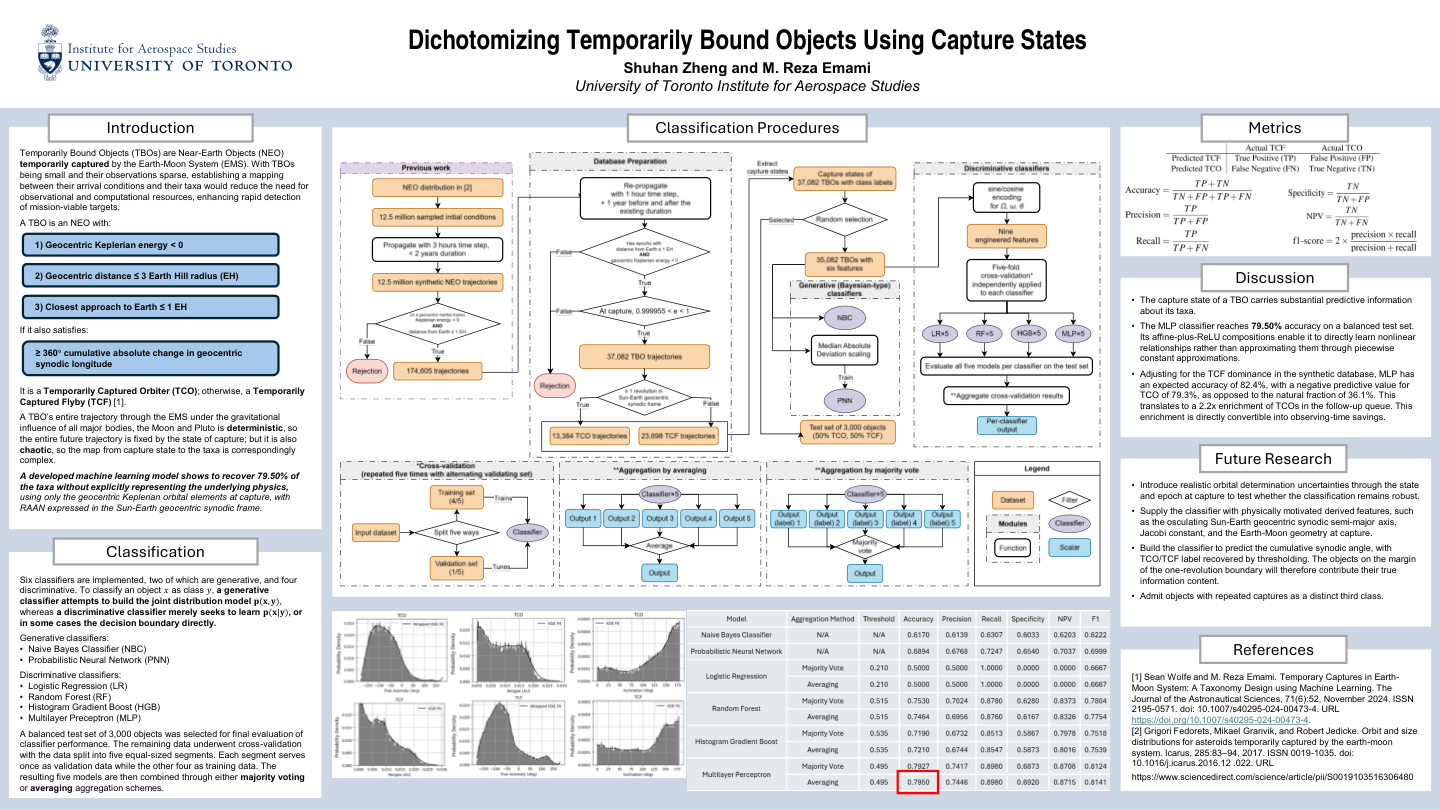
Temporarily Bound Objects (TBOs) are Near-Earth Objects that become temporarily captured by the Earth-Moon system. They are classified as Temporarily Captured Orbiters (TCOs) when they complete a full revolution around Earth, or Temporarily Captured Flybys (TCFs) when they do not. Determining that class early can reduce the need for prolonged numerical propagation and help observers identify mission-viable targets sooner.
This first-author study, conducted with Professor M. Reza Emami at the University of Toronto Institute for Aerospace Studies, investigates whether the orbital elements at the instant of capture contain enough information to predict a TBO’s subsequent class.
Technical Approach
The study uses a dataset of more than 37,000 synthetic TBO trajectories. Six classification methods were implemented and compared: Naive Bayes, a Probabilistic Neural Network, Logistic Regression, Random Forest, Histogram Gradient Boosting, and a Multilayer Perceptron. Each model uses orbital information available at capture to distinguish TCOs from TCFs without explicitly propagating the object’s complete future trajectory.
Key Results
The Multilayer Perceptron achieved the strongest performance, reaching 79.50% accuracy on a balanced test set of 3,000 objects. When adjusted for the natural class distribution in the synthetic population, the model achieved an expected accuracy of 82.4% and a 2.2x enrichment of TCOs in the follow-up queue. These results show that capture-state orbital elements carry substantial predictive information and could help direct limited observation time toward promising targets.
Publication Status
The manuscript has been submitted to the Advanced Maui Optical and Space Surveillance Technologies Conference (AMOS) 2026.